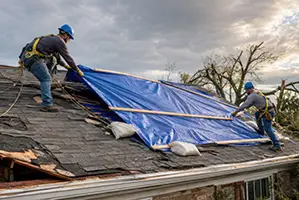
HOA Winter Preparation: Getting Ready For Super El Nino In Colorado

With the cold season coming, HOA winter preparation becomes a priority. Due to the forecasted Super El Niño in Colorado, board members must adjust their typical routine to accommodate the shift. These adjustments can help ensure that the community and its residents are ready for what’s ahead.


How Super El Niño in Colorado Affects HOA Winter Preparation

The National Oceanic and Atmospheric Administration (NOAA) predicts a record-setting Super El Niño in the United States this year. With this, shifting weather patterns are on the horizon for Colorado in the coming months.

While lead meteorologist Scott Handel emphasized that “no two El Niños are exactly the same,” there are some assumptions that can be made based on past El Niño events. An active winter is expected in Colorado, but a major snow season is not guaranteed. Historically, above-average snowfall takes place in the mountains, especially the San Juan Mountains.

The Front Range, on the other hand, may experience an increase in snowfall due to the large spring storms that El Niño can bring, but it is uncertain. If the subtropical jet stream moves north, Colorado could see a very wet winter. Conversely, if it remains south, the state may have a much less snowy season.

In lower elevations, warmer temperatures could reduce snowfall. These areas may experience rain instead, but nothing is definite.

Moreover, experts predict that winter may begin late but progress in activity later. Climate models point toward a busy mid-to-late winter, even extending to the spring season.


How to Winterize HOA Community

Given the variability that an El Niño Colorado winter brings, HOAs and condominiums must prepare for every possibility. In general, here are the best strategies for HOA winter preparation, as supplemented by Colorado’s own hazard-planning guidance.


1. Inspect Roofs and Drainage Systems

Before winter comes, boards should hire a professional to inspect the association’s roofs and drainage systems. For HOAs, the focus is more on association-managed properties, such as clubhouses, fitness centers, and other facilities. For condominiums and townhomes, there are more shared roofs and drainage systems to worry about.

Inspection items should include roofs, gutters, downspouts, drainage, foundations, and other exterior components. Check ice dam-prone areas, identify and seal potential leaks, and look for signs of previous water intrusion. Address areas where snow tends to accumulate.


2. Prepare for Both Snow and Ice

A big part of HOA winter preparedness should address snow and ice. While snow is a variable with Super El Niño, it still helps to have a written plan for snow plowing, sidewalk clearing, deicing, and ice monitoring. Boards must also consider emergency access, fire-lane access, entryways, stairs, and parking lots.


3. Check Heating Systems Before Temperatures DropSuper El Niño Colorado

Communities with shared heating systems must prioritize maintenance and winterization. Furnaces, boilers, heating equipment, ventilation systems, and other components must undergo thorough inspection before the cold season.

The association should identify emergency heating procedures, equipment with a history of failure, and areas that are more prone to freezing. It is also essential to have backup power available at all times. Other than that, should systems fail, the board must have a provider for after-hours service.


4. Protect Pipes and Water Systems

When it comes to HOA winter preparation, frozen and burst pipes should always be part of the list. Exposed pipes are more likely to freeze and burst, so inspection and winterization are essential. Make sure to properly insulate these pipes and seal any drafts around the areas where the pipes sit. In case of a burst pipe, board members must know where the shutoff valves are located.


5. Review Snow Removal Contracts Now

Some associations wait until the first storm to check their snow removal contract, only to find that it doesn’t cover what the community needs. A big part of Colorado winter weather preparation is having a snow-removal vendor on standby at all times.

When reviewing the contract, make sure to check the trigger depth for service, response times, plowing and sidewalk responsibilities, deicing services, ice monitoring, snow relocation, emergency service, and communication procedures. If additional storms or services are required, the contract should also specify pricing models for them.


6. Inspect Trees and Landscaping

Snow, ice, and wind can cause branches to break off and trees to fall. These are clear safety hazards and can also damage private property. Proper HOA winter storm preparation includes inspecting trees that stand near buildings, sidewalks, parking areas, roads, utility lines, and community amenities.

If there are hazardous or diseased branches, make sure to prune them before the winter season. Board members can’t do this alone, not without the right expertise and equipment, so hiring a professional is necessary.


7. Check Emergency Supplies and Procedures

Every HOA winter emergency plan should include well-stocked supplies, clear procedures, and a list of important contacts. The association should regularly update contact information for its providers, including the management company, the snow contractor, plumbers, the HVAC contractor, electricians, the roofing contractor, tree service, the insurance carrier, and emergency services. Emergency supplies must include ice melts, flashlights, batteries, and backup equipment.


8. Review Insurance and DeductiblesEl Niño Colorado winter

Insurance plays a significant role in winter, especially when emergencies arise. Boards should take a good look at the association’s master insurance policy, particularly property coverage, general liability coverage, deductibles, and exclusions.

Some policies have separate wind or hail deductibles, while others also cover water damage claims. Reviewing insurance helps determine what the HOA is responsible for and what owners are responsible for. It also allows the board to get a grasp of the claims filing process.


9. Review the Reserve Fund Before Winter

The HOA’s reserve fund can come in handy when winter storms cause costly repairs. Roofs, drainage systems, sidewalks, heating systems, pavements, and other exterior components are most likely to experience damage. Boards must ensure the association has sufficient reserves to cover repairs or replacements if insurance coverage is inadequate.


10. Prepare for Unusual Temperature Swings

Super El Niño comes with unusual temperature swings. Because of this, HOAs and condos in Colorado must prepare for an ongoing rotation of snow, melting, refreezing, ice, and additional snow. A wet winter brings slippery walkways, drainage issues, roof leaks, ice dams, and damage from the freeze-thaw cycle.


11. Communicate Responsibilities to Homeowners

While the association is responsible for shared areas and common elements, it is not responsible for individual homes or units. Of course, that doesn’t mean the board must remain idle.

To prepare the whole community, boards should remind owners of their winter maintenance obligations. Even a simple notice works. This notice can include tips for winterization, instructions on how to report leaks or frozen pipes, and directions for emergency requests.


HOA Winter Maintenance Checklist

Here is a quick rundown of the tasks involved in HOA winter preparation:

  • Inspect roofs, gutters, drains, and exterior building components
  • Inspect heating systems and vulnerable plumbing
  • Confirm snow and ice removal contracts
  • Identify snow storage and emergency access areas
  • Inspect trees near buildings, roads, and utilities
  • Stock winter maintenance and emergency supplies
  • Review insurance policies and deductibles
  • Review reserve funding for components
  • Document known deficiencies before the season begins
  • Create procedures for frozen pipes, roof leaks, heating failures, and storm damage
  • Confirm contractor and emergency contact information
  • Tell homeowners what the association maintains and what owners are responsible for


An Uncertain Season

In Colorado, the forecasted Super El Niño has made it difficult for boards to plan for the winter season. With several variables at play, HOA winter preparation must account for every possibility. Dry snow is not a guarantee, and a more active freeze-thaw cycle may result in greater damage and more safety hazards. When in doubt, a professional HOA management company can help.

Westward360 is a trusted partner for HOAs and condo associations across the United States, including Colorado. To get started on expert association management, contact us today or request a proposal online!


What Can HOA Boards Do About Rising HOA Insurance Costs?

Rising HOA insurance rates are crippling association funds, leading to reduced coverage, higher dues, and budget shortfalls. As insurance is a must for many communities, boards are struggling to meet insurance requirements while still maintaining a healthy financial position. Fortunately, there are some strategies boards can employ to minimize the effects of insurance spikes.


Factors That Affect Rising HOA Insurance

Homeowners associations and condominiums are responsible for protecting their finances and physical assets. This typically comes in the form of insurance. In fact, many states require HOAs and condos to maintain adequate coverage.

Yet in recent years, insurance has become an expensive line item in most community budgets. The Foundation for Community Association Research discovered that 93% of managed associations have suffered an increase in insurance rates. Master policies have increased by 90.4% over a two-year period.

Premiums are rising, and coverage has decreased significantly. Carriers are even discontinuing service to community associations entirely, thereby limiting options and causing costs to spike even further.

When determining rates, carriers consider several factors, such as:

  • The type of community
  • The association’s governing documents
  • Total replacement cost
  • Deductibles and exclusions
  • The age of the building or assets
  • Square footage and number of units
  • Risk exposure and mitigation practices
  • Relevant geographic risks
  • Claims history
  • Amenities and facilities
  • The type of construction

Insurance premiums can vary greatly from one association to another. Two HOAs in the same area can have considerably different costs depending on their profiles.


What’s Causing High HOA Insurance Costs?

There are two main causes affecting insurance costs: inflation and severe weather events.

Inflation is rising rapidly, driving up the cost of construction materials and labor. As prices rise, claims are becoming more expensive for carriers, prompting them to raise insurance rates.

Weather events are also becoming more extreme and unpredictable. North America has been experiencing more frequent hurricanes, wildfires, and floods. These natural disasters are making carriers suffer significant losses.

When combined, inflation and weather have made it riskier for carriers to insure HOAs and condominiums. Those that still provide coverage are becoming more selective, implementing stricter underwriting standards.

Because of these factors, communities now face higher premiums, larger deductibles, more exclusions, and decreased coverage.


What Can Boards Do About Increasing HOA Insurance Costs?

Associations can cope with rising HOA insurance premiums by reviewing their coverage every year, maintaining strong insurance and property records, prioritizing preventive maintenance, budgeting for higher insurance costs, evaluating deductibles against HOA funds, shopping the insurance market carefully, communicating insurance costs with homeowners, and focusing on insurability (not just premiums).

Let’s discuss each strategy below.


1. Review Insurance Coverage Every Year

Boards must evaluate their HOA insurance policies annually. Waiting until the renewal date comes along may already be too late.

Regular reviews, particularly with an insurance professional, can help identify gaps in coverage and determine if the HOA is in a good financial position to accommodate the policy. The review should cover policy limits, exclusions, deductibles, replacement costs, and potential exposure risks.

Replacement costs are especially important. The value of buildings can change drastically as construction and labor costs rise. If an HOA uses an outdated replacement cost estimate, the carrier may require a substantial increase in coverage. This, in turn, can result in higher premiums.


2. Maintain Strong Insurance and Property Records

rising hoa insurance premiums

Now more than ever, insurance carriers look for documentation that shows how an HOA manages its property and mitigates risks. Boards should maintain clear and accurate records that they can easily provide when renewing their policy or filing a claim.

While records can vary from one community to another, it is generally recommended to maintain the following:

  • Maintenance history and completed repairs
  • Roof replacements and inspections
  • Plumbing and electrical upgrades
  • Balcony inspections and repairs
  • Fire alarm and sprinkler inspections
  • Safety inspections
  • Wildfire mitigation and defensible space work
  • Vendor contracts
  • Reserve studies
  • Incident and claims reports
  • Meeting minutes related to major maintenance or risk management decisions


3. Prioritize Preventive Maintenance

Maintenance plays a significant role in minimizing property damage and liability claims. Boards should conduct regular inspections for all components and maintain records of these checks. A review of the association’s claims history can also help identify recurring problems or patterns.

For example, if the HOA consistently files water-damage claims, it may indicate a larger plumbing issue. Addressing the root cause can prevent breakdowns and minimize future claims. Carriers feel more confident in providing coverage when the association shows its commitment to preventive maintenance.


4. Budget for Higher Insurance Costs

Boards have no direct influence over rising HOA insurance, so it’s important to focus on what they can control — and the budget is one of them. Since insurance is required for most associations, boards must include it in their long-term financial planning. It’s best to assume that insurance will continue to rise rather than hope it will soon level off.

Every new year’s budget should account for a higher premium than the last. This gives the board a cushion of sorts, allowing dues to adjust accordingly and making special assessments less likely.


5. Evaluate Deductibles Against HOA Funds

Higher deductibles allow for lower premiums, but the board must consider whether the association can comfortably cover the amount after a loss. It may seem prudent to raise deductibles now, but an HOA can’t pay for them after a loss if its reserve or operating accounts are inadequate.

When evaluating insurance policies, boards should compare potential deductibles with available funds. Moreover, boards should verify that homeowners have sufficient loss assessment coverage on their respective HO-6 policies.


6. Shop the Insurance Market Carefully

While sticking with the same carrier might show loyalty, it can trap an association into a corner. Board members should shop around every now and then to look for more competitive rates. If the current carrier raises its premiums, it is worth checking what other carriers in the market charge for the same policy.

Of course, price shouldn’t be the sole consideration. Boards should also compare deductibles, exclusions, claims service, and coverage.


7. Communicate Insurance Costs with Homeowners

increasing hoa insurance costs

Insurance is often one of the largest line items in an HOA budget, contributing to higher dues. Homeowners may protest the expense, but this is usually because they don’t quite understand what’s going on behind the scenes.

Boards should explain the changes in insurance costs and the factors affecting premiums. It is also a good idea to communicate what steps the HOA is taking to manage its insurance expenses. Communication helps limit pushback and reduce delinquencies.

Additionally, boards must inform owners of their own insurance responsibilities. In general, they must each carry an HO-6 policy with adequate loss assessment coverage.


8. Focus on Insurability, Not Just Premiums

While the premium itself is important, boards should not focus only on that. Insurability is the chief concern, with factors such as claims history, maintenance, building age and condition, and financial planning all playing a role. Market conditions are beyond the board’s control, so it’s better to focus on addressing preventable risks and keeping the community attractive to carriers.


The Best Way Forward

Whether they like it or not, association boards must deal with rising HOA insurance costs. Eliminating insurance from the budget altogether isn’t an option, but preparation and risk mitigation can help make insurance rates more manageable. When in doubt, consulting an HOA management company or insurance professional is recommended.

Westward360 is a trusted partner for HOAs and condo associations across the United States. To get started on expert association management, contact us today or request a proposal online!


Is Your HOA Reserve Funds Enough?

Community associations rely on HOA reserve funds for major repairs and replacements. Yet, far too often, these reserves are nowhere near the right level of funding. Healthy reserves prepare the association for the future, and boards can gauge whether or not they have enough funding by following simple practices.


What are HOA Reserve Funds?

The homeowners association reserve fund consists of money used to pay for major repairs and replacements once capital components reach the end of their useful life. It essentially functions as a savings account, set aside for long-term expenses.

Reserves play a crucial role in preserving the association’s finances and assets. Without properly funded reserves, boards would need to defer maintenance, levy special assessments, significantly raise dues, or take out a loan to cover the shortfall.


What are the HOA Reserve Requirements?

State laws and the governing documents determine if an association is required to fund reserves.

Currently, only 12 states require condo associations to fund reserves. These are Connecticut, Delaware, Florida, Hawaii, Illinois, Maryland, Massachusetts, Michigan, Minnesota, Nevada, Ohio, and Oregon. Condominiums have broader maintenance responsibilities because they have more shared elements.

Apart from HOA reserve fund laws, board members must also review their CC&Rs and bylaws. Even if state laws are silent, the governing documents may mandate reserve funding.


What Can HOA Reserve Funds Be Used For?

Depending on the governing documents, an association can generally use HOA reserve funding to cover repairs and replacements of major components or infrastructure.

Examples include:

  • Fixing or replacing roofs on shared buildings such as clubhouses or security gates
  • Repaving community parking lots, private streets, and shared driveways
  • Resurfacing community swimming pools
  • Upgrading playground equipment
  • Replacing shared HVAC systems, elevators, or fencing in common areas

That said, associations generally can’t use reserve funds to pay for operating expenses, such as routine maintenance and management fees. That’s what the operating fund is for.


What is the Right HOA Reserve Funding Percent?

Ideally, an association should aim to keep its reserves between 70% and 100% funded at all times.

There is no exact dollar amount that works for all associations. Every community has different needs, infrastructure, and risks. Even when two buildings are constructed exactly alike, they can differ in wear, damage, and long-term use.

To determine the right funding level, associations must conduct a reserve study. This study identifies the major capital components of the HOA, how much useful life they have remaining, and the cost to repair or replace them. That said, the HOA reserve rule of thumb is to have at least 70% of its funding needs covered at any time.


What are the HOA Reserve Funding Strategies?

There are three funding strategies for HOA reserves: full funding, threshold funding, and baseline funding. Let’s break these down below.


1. Full Funding Strategyhoa reserve funding

A full funding strategy aims to keep the reserve balance at or near 100% of the calculated amount in the reserve study.

This strategy offers maximum protection, as it ensures that the association can cover all of its reserve costs. Of course, it may require higher reserve contributions over a shorter period.


2. Threshold Funding Strategy

A threshold funding strategy establishes a minimum percentage that’s considered safe for a reserve balance. Typically, this is 70% of the fully funded amount as indicated in the reserve study.

Threshold funding balances risk mitigation and affordability for homeowners in terms of reserve contributions. For this reason, it is the most favored funding strategy.


3. Baseline Funding

A baseline funding strategy sets contributions just high enough to keep the reserve balance from reaching zero at any time. This strategy keeps HOA dues low, but it doesn’t leave much room for error or unexpected costs. There is also a higher risk of special assessments.


Drawbacks of Underfunded HOA Reserves

When an association lacks adequate reserves, it can face consequences.

The need for major repairs and replacements will eventually catch up. When that time comes, if the HOA doesn’t have sufficient reserves, it will have to levy large special assessments or significantly raise dues. Another option is to take out a loan from a bank, but that’s only a temporary fix. Owners must still be held responsible for repayment.

Apart from the financial impact, underfunded reserves can also have legal implications. Board members have a fiduciary duty to maintain the association. Poor reserve planning and the resulting inability to repair or replace components may constitute a breach of this duty. Owners may take legal action against the HOA and even the board members themselves.

Without money, boards will need to defer major repairs and replacements. This can cause irreversible damage and deterioration, thereby lowering curb appeal and property values. In the end, homeowners won’t get a satisfactory return on their investment.


How are HOA Reserves Funded?

Reserves are funded by the homeowners, with a portion of their regular dues allocated as the HOA reserve contribution.

Board members rely on an updated reserve study to determine how much each owner must contribute to the reserves. Gradual contributions through regular dues are the norm, but the board may turn to large special assessments if its reserves are underfunded and a major repair is scheduled soon.


Are HOA Reserve Funds Taxable?

In general, reserve contributions are not taxable income, but the interest or investment earnings on those funds are.

If an HOA wishes to prevent the IRS from classifying reserves as taxable income, it should follow specific accounting practices. These include keeping the reserves completely separate from the operating funds and only spending the reserves on major capital repairs or replacements.


Best Practices for HOA Reserve Fund Management

Managing the reserves requires discipline, compliance, and expertise. Professional HOA management can help with reserve planning and oversight, but self-managed boards must rely on the following tips.


1. Keep Accounts Separatehoa reserves rule of thumb

Associations must always keep the HOA reserve account and operating account separate. Commingling funds not only makes it harder to track money but can also render the reserves taxable. Remember that operating funds pay for day-to-day expenses, while reserve funds cover major capital repairs and replacements.


2. Conduct a Reserve Study

A reserve study can determine the condition of each major component, its remaining useful life, and the total repair or replacement cost. It also comes with a funding plan that ensures an HOA has sufficient reserves.

Several states require associations to perform a reserve study every few years. In Virginia, for instance, HOAs must conduct this study once every five years to account for economic changes and evolving market projections (Section 55.1-1826). Even without a statutory requirement, boards would be wise to hire a professional reserve specialist to conduct this study.


3. Invest Wisely

Since reserves tend to remain stagnant for several years, associations may wish to invest them to maximize returns. That said, when choosing investment plans, the board must always prioritize safety and liquidity while keeping FDIC insurance limits in mind.


The Best Way Forward

The HOA reserve funds play an essential role in long-term capital planning and financial stability. Board members must maintain a healthy funding level and employ the industry’s best practices. When in doubt, hiring an HOA management company can help.

Westward360 is a trusted partner for HOAs and condo associations across the United States. For expert association management, contact us today or request a proposal online!


HOA Special Assessment: When Reserves Aren’t Enough

An HOA special assessment can come in handy during times of financial crisis. That said, there are certain requirements, procedures, and limitations involved. Board members must understand how special assessments work to ensure compliance and avoid liability.


What is an HOA Special Assessment?

A special assessment is an additional fee that an HOA collects from homeowners on top of their regular dues.

Unlike dues, HOA special assessments are one-time charges. This means that they do not recur, only coming up if the association requires an extra cash injection. The purpose of a special assessment is to pay for unexpected costs that the operating budget, reserve fund, or insurance can’t cover.


Can an HOA Levy Special Assessments?

The answer depends on state laws and the association’s governing documents.

Some state laws explicitly give HOAs and condominiums the authority to levy special assessments. One such example is Virginia. Under Section 55.1-1825 of the Property Owners’ Association Act, an HOA may impose an additional assessment if it serves the association’s best interests and the purpose is primarily for common area maintenance and upkeep.

When state laws are silent, board members must refer to their CC&Rs and bylaws. Even if state laws grant express authority, many governing documents enforce additional requirements or procedures that boards must follow when levying HOA special assessments.


What is an HOA Special Assessment For?hoa special assessments

In general, an HOA special assessment is used to cover emergency repairs, budget deficits, capital improvements, or underfunded reserves.

  • Emergency Repairs. If insurance doesn’t cover a repair caused by an emergency, such as a natural disaster, a special assessment can step in.
  • Budget Deficits. A special assessment can cover shortfalls in the budget caused by unexpected costs or high delinquency rates.
  • Capital Improvements. When the HOA needs to fund a large project, such as a renovation, it may turn to special assessments if its current funds are inadequate.
  • Underfunded Reserves. Associations can use special assessments to bridge the gap when the reserve account isn’t at a healthy funding level.

While these are common examples, boards must check their governing documents. Some CC&Rs and bylaws limit what associations can use special assessments for.


Is There an HOA Special Assessment Limit?

It depends on state laws and the association’s governing documents. Most states don’t impose a ceiling for special assessments, instead letting associations rely on their CC&Rs and bylaws.

One notable exception is California. Under Civil Code Section 5605, an HOA board can impose a special assessment of up to 5% of the association’s budgeted gross expenses for the current fiscal year without member approval, even if the governing documents set different limits.

Some CC&Rs and bylaws place a percentage limit on special assessments, while others have a strict dollar cap. There are also those that require membership approval when exceeding a certain percentage or amount.


HOA Special Assessment Rules to Know

Requirements and procedures for HOA special assessments can vary from one association to another. It is important to check the governing documents for specific guidance.


Required Vote (Board or Membership)

Many CC&Rs and bylaws require a vote of approval to pass a special assessment, either from the HOA board or the entire membership. Board approval is easier to obtain, as it usually requires only a majority vote of the directors.

Membership approval, on the other hand, is trickier. Most governing documents require a supermajority or a specific voting threshold to approve a special assessment. Since this assessment is an additional charge, boards often struggle to secure the necessary votes, as most owners don’t want to pay another fee.

Still, education is key. If owners understand the purpose of the assessment and how it will benefit the community as a whole, they are more likely to support the proposal.

Of course, there is typically an exception that allows the board to bypass a vote. If the expense addresses an emergency safety or health issue, approval may not be needed.


HOA Special Assessment Notice

Depending on the governing documents, associations must give homeowners formal written notice of the special assessment. This notice must detail the cost of the assessment, the reason for it, and the payment deadline. While timeframes can vary, most CC&Rs and bylaws require 30 to 60 days’ advance notice.


Calculations

In some communities, the special assessment must address a funding cap. This is calculated by subtracting the insurance payouts and available reserve funds from the overall cost of the project.


Cost Allocation

Depending on the CC&Rs and bylaws, the allocation of the assessment follows a specific formula. Most communities split the cost equally among all homeowners. Meanwhile, others allocate the cost based on property size or type.


Payment Termshoa special assessment rules

Associations often allow owners to pay their assessments either in a lump sum or in installments over several months. It usually depends on the association’s governing documents and the urgency of the need.


Designated Use

Most governing documents require the board to use the special assessment solely for the proposed or communicated purpose. For example, if the board approved the special assessment for a landscaping project, it can’t use the surplus to fund a community event.


How Often Should an HOA Levy a Special Assessment?

A healthy HOA should rarely impose a special assessment on its residents.

Associations are responsible for financial planning and management. This includes projecting operating costs and allocating appropriate reserves based on a reserve study. If the budget doesn’t fall short and the reserves can cover all major projects, then there shouldn’t be a need for HOA special assessments. The key is to make prudent financial decisions.

If an HOA frequently charges additional assessments, it may indicate a bigger problem. The board should investigate the cause and address it at its root. For example, if special assessments are consistently triggered by unexpected repairs, it could be traced back to a lack of preventive maintenance. Similarly, an outdated reserve study with obsolete funding recommendations may result in underfunded reserves.


Is an HOA Special Assessment Tax Deductible?

No, special assessments that an HOA collects are generally not considered taxable income. This means that the association doesn’t pay income tax on these charges.

That said, there is a condition. To remain non-taxable, the association must use the special assessment for exempt functions, such as managing and maintaining HOA-owned property. This includes using the money on repairs or capital improvements.


Treading Carefully

When used correctly, an HOA special assessment can be a practical financial tool. This additional charge can help improve cash flow and keep an association financially solvent. That said, it comes with certain limitations and requirements that can vary from one community to another. Reviewing state laws and governing documents can help ensure compliance.

Westward360 is a trusted partner for HOAs and condo associations across the United States. For expert association management, contact us today or request a proposal online!


Who Can Run For The Board? Understanding HOA Board Nominations

Every association election begins with an HOA board nomination process. Before owners can cast their votes, the HOA must determine who can run, how candidates are nominated, and what steps the association must follow. Understanding these rules can help the community run a fair and consistent election.


What is an HOA Board Nomination?

An HOA board nomination is when someone puts a homeowner’s name forward as a candidate for election.

Depending on state laws and the association’s governing documents, owners may nominate themselves or another eligible member. Nominations usually take place before the HOA election. Procedures can vary, but most communities require candidates to submit a nomination form and meet eligibility requirements.


Who Can Be on HOA Board?hoa board nomination process

In general, any member in good standing may run for a position on the board, but qualifications can still vary depending on state laws and the governing documents. For instance, in Florida, Section 720.306 allows any member to serve on the board except delinquent owners.

Common eligibility requirements include:

  • Membership. The person must generally be an HOA member, meaning they own a home or unit in the community.
  • Good Standing. Some associations require candidates to be current on dues and assessments.
  • Age Requirements. Some bylaws require board members to be adults.
  • No Disqualifying Conditions. Certain legal circumstances may prevent a person from running, such as being in active litigation with the HOA or having past criminal convictions that would hinder the association from securing fidelity insurance.


How to Nominate HOA Board Members

There are several ways to nominate a candidate, including self-nomination, nomination by another member, nomination through the HOA nomination committee, floor nominations, and write-in nominations. The association’s governing documents determine which methods are permitted.

Let’s discuss each one below.


1. Self-Nomination

This method allows homeowners to nominate themselves for an open board position. Self-nominations work well because interested homeowners can simply throw their hat into the ring without waiting for someone else to submit their name. To self-nominate, the owner may need to complete a particular form.


2. Nomination by Another Member

Homeowners may nominate another eligible member to run for the board. Depending on the rules, the nominee may need to accept the nomination before officially running. It is possible that a nominee may not want to serve on the board and reject the nomination.

Some associations require owners to submit the HOA board candidate nomination in writing. Meanwhile, others allow verbal nominations from the floor.


3. HOA Nomination Committee

Some HOAs appoint a nominating committee. This committee is responsible for identifying and recruiting potential candidates. It’s particularly helpful for communities that struggle to attract volunteers.

Nominations by this committee generally work the same way. They must submit the nomination in writing, usually along with the nominee’s written acceptance. Sometimes, the committee is only given advisory authority, providing the board with a list of qualified candidates.


4. Floor Nominationshoa candidate nomination form (please make one)

Some associations allow owners to nominate candidates from the floor. Floor nominations can take place either at a scheduled meeting before the actual elections or during the election meeting itself. In the latter case, those who have already submitted their ballots may no longer vote for candidates nominated from the floor.


5. HOA Write-in Nomination

A write-in nomination allows a voter to manually enter the name of an owner who isn’t included in the official list of candidates. If an HOA allows write-in candidates, paper ballots must include a blank line, and electronic ballots must include a text box for voters to enter their choices.

Of course, when counting votes, it is important to verify the write-in candidate’s eligibility. Even if they secure enough votes to win, they can’t be counted if they don’t qualify for the position.


What are the Steps in the HOA Board Nomination Process?

The HOA board nomination process includes the following steps: reviewing the governing documents, announcing the election and opening nominations, collecting candidate nominations, verifying candidate eligibility, and publishing the final candidate list. From there, the election can proceed as normal.


1. Review the Governing Documents

Before opening nominations, the HOA board or election committee must confirm the requirements and procedures set forth in the governing documents. These documents may establish which board seats are up for election, who may qualify as a candidate, and the process and deadline for nominations.

Additionally, the bylaws or election rules typically address the nomination methods that the HOA may use. For example, an HOA may not allow floor nominations if candidates are pre-nominated before the election meeting proper. These documents may also determine if a nominating committee is required.

It is important to establish written nomination rules and procedures that the HOA must follow every year. Changing these rules with each new election can undermine consistency and lead to claims of invalid elections.


2. Announce the Election and Open Nominations

After confirming the rules, the HOA must then officially announce the election and open nominations by sending written notice to homeowners. This notice must also identify the open seats, explain how owners can become candidates, and outline the eligibility requirements. Other than that, the notice must clearly state the nomination deadline and the election date.


3. Collect Candidate Nominations

The next step is to collect candidate nominations. Candidates must submit the required materials before the deadline. Depending on the association, these materials can include a nomination form, a candidate statement, and a completed questionnaire.

If the association has a nominating committee, it may interview candidates or review submitted documents. From there, the committee can finalize the slate of candidates for election. Keep in mind that the exact process can vary depending on the governing documents.


4. Verify Candidate Eligibility

Not all nominees may move on. Associations generally have qualifications that candidates must meet. Before publishing the official candidate list, the HOA must confirm that each nominee is eligible to serve on the board.

Requirements can vary, but they typically include membership status, good standing, minimum residencies, term limits, and other qualifications. After verifying the nominees, the association can prepare the ballots.


5. Publish the Final Candidate Listwho can be on hoa board

Associations must make sure that voters are properly informed. Homeowners must get to know the candidates so they can decide whom to support. The final candidate list should include the candidates’ names, biographical information, and candidate statements.

The HOA must publish this list according to its bylaws. Some post it on the community website or distribute it via written notice. Others include it in their newsletters or hold separate campaign meetings for a more personal experience.

Of course, if an association allows floor nominations (during the election meeting) or write-in candidates, owners may vote for someone not in the final candidate list. That said, even floor and write-in candidates must undergo the same verification process when votes are counted.

While self-managed communities can certainly facilitate the nomination process, hiring an HOA management company can ensure fairness and ease.


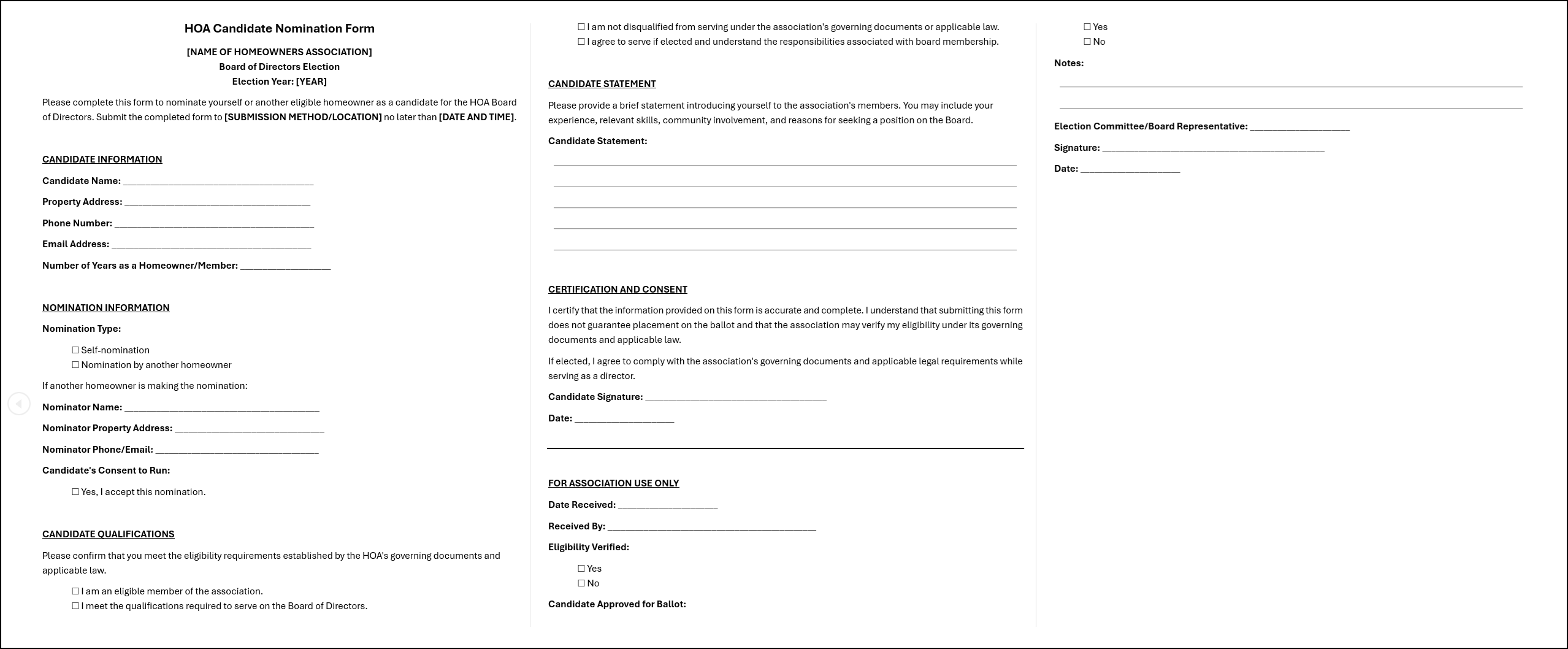
Sample HOA Candidate Nomination Form

Download Your HOA Candidate Nomination Form Here

sample hoa candidate nomination form


For Smooth Nominations

The HOA board nomination process helps associations identify eligible candidates before an election. Board members and nominating committees must follow their governing documents and nomination procedures to avoid problems. Each nominee must be carefully verified so that their qualifications aren’t called into question should they win.

Westward360 is a trusted partner for HOAs and condo associations across the United States. For expert association management, contact us today or request a proposal online!


How Do HOA Elections Work? A Guide For Association Boards

In any planned community, HOA elections play a central role in ensuring continuity of leadership. Board members must understand how the election process works and what requirements must be met. Otherwise, owners can challenge the results, rendering the entire election invalid.


What are HOA Elections?

Homeowners association elections are a democratic process in which members vote for candidates to serve on the HOA board.

Every association is governed by a group of leaders known as the HOA board of directors. Board members are responsible for managing the community, including dues collection, rule enforcement, and common-area maintenance. That said, these board members don’t stay in power indefinitely.

After a board member serves out their term, the seat is up for election. Candidates are nominated either by themselves or by their fellow owners. If a candidate secures enough votes, they replace the outgoing director.


What are the Steps in an HOA Election Process?

The election process involves identifying open positions, finalizing the electoral roll, opening nominations and notifying owners, sending a pre-ballot notice, voting, counting the votes, announcing and recording the outcome, and electing officers. Let’s discuss each step below.


1. Identify Open Positions

First, the board or election committee must determine which seats are up for election in the new year. Most associations stagger term lengths so that not all board seats become vacant at the same time. This ensures that there’s a combination of new and veteran board members.


2. Finalize Electoral Roll

The electoral roll is essentially a list of all eligible voters’ names, voter numbers, property or unit numbers, and contact information. It is important to update this list so that the HOA may account for all eligible voters. Associations must add new homeowners to the list and remove any owners who have sold their homes.

Eligibility may not rely solely on ownership, too. Some associations revoke voting rights from delinquent members or those with pending violations. Eligibility requirements ultimately depend on the association’s governing documents.


3. Open Nominations and Notify Ownershoa election process

Next, the HOA board or election committee must officially open nominations. Nomination methods and requirements are typically defined in the association’s governing documents.

That said, state laws can also pose certain limitations. For instance, in Florida, floor nominations during the election meeting may be prohibited if the HOA has an established process requiring nominations to occur before the meeting (Section 720.306).

Additionally, owners must be notified of the open positions, the nomination deadline, and the procedures for nominating candidates. Notification periods can vary, but it’s usually 30 days before the nomination deadline.


4. Send a Pre-Ballot Notice

After receiving the candidate nominations, the HOA must send a pre-ballot notice to all homeowners. This notice should include the list of candidates officially in the running, how owners can cast their votes, and the meeting details for counting the ballots. Again, notice periods differ by association, but it’s normally 30 days before the distribution of ballots.


5. Vote

During the election period, members can either send their ballots or attend the election meeting in person to cast their votes. The appropriate voting method will depend on the association’s governing documents and election rules, but options typically include:

  • Written ballots
  • Electronic ballots
  • Secret ballots
  • Proxy votes

Some associations use a combination of these methods.


6. Count the Votes

An HOA must clearly establish a voting deadline. The association will no longer count any ballots submitted by owners after this date.

When counting the votes, it is important to examine each ballot to verify voter eligibility and ballot validity. Some ballots may be invalid if they’ve been faked or there’s a duplicate. Ballot counting typically takes place at the election meeting itself, with candidates and homeowners acting as witnesses. It ultimately depends on the association’s election rules.


7. Announce and Record the Outcome

After confirming the count, the HOA board or election committee must announce the results. This usually takes place at the election meeting. Most associations also post the results on the community website or send an official notice to all homeowners.


8. Elect Officershoa election of officers

The HOA election of officers is not the same as simply electing board members. While homeowners elect the latter, officer roles are generally determined by the board. For example, if the roles of secretary and treasurer are open, the board votes on who among the two winners will take each seat.


What Should HOA Election Rules Include?

Generally, an association’s election rules should address candidate qualifications, nomination procedures, voter eligibility, permitted voting methods, campaign procedures, voting deadlines, and ballot counting procedures.

  • Candidate Qualifications. These determine who may run for open board positions.
  • Nomination Procedures. These explain how owners may nominate candidates for election.
  • Voter Eligibility. This establishes who has a right to vote.
  • Permitted Voting Methods. These identify the voting method/s the association may use, such as written ballots, secret ballots, online voting, and proxy votes.
  • Campaign Procedures. These outline how candidates may run their campaigns, whether they can use common areas, and whether they can utilize HOA resources to spread information.
  • Voting Deadlines. This simply establishes the voting period and the deadline for owners to submit their ballots.
  • Ballot Counting Procedures. These determine how the association must count the votes, where the tabulation should take place, and who may observe the process.

Every community is different, so the specifics of these rules can vary. For instance, one HOA may allow delinquent owners to vote in the elections, while another may revoke their voting rights. The governing documents typically establish the voting rules that an association must follow.


How Often are HOA Elections Held?

In general, HOA elections occur at the annual meeting, but associations may skip an election if there are no open seats.

Term lengths are a determining factor. Some associations stagger term lengths into 1-, 2-, or 3-year terms so that seats open every year. Meanwhile, others allow board members to serve concurrent 2- or 3-year terms, meaning elections occur only every 2 or 3 years.

Associations must check their bylaws for term lengths and election requirements.


Who Organizes HOA Elections?

It depends on state laws and the governing documents, but most are organized by a separate HOA election committee.

This committee is responsible for overseeing and facilitating a fair and smooth election. Depending on the governing documents, any HOA member may join the election committee. That said, some associations prohibit incumbent directors or candidates from joining to avoid conflicts of interest.

Moreover, some associations hire a third-party inspector to supervise the process and count the ballots. California even requires it (Civil Code Section 5110).

An HOA management company can also help by scheduling elections, sending the required notices, preparing ballots, and ensuring compliance with election rules.


A Successful Process

Preparing and holding HOA elections isn’t always smooth sailing, especially when election rules are unclear. Board members can improve the process through careful planning and coordination, all while ensuring compliance with state laws and the governing documents.

Westward360 is a trusted partner for HOAs and condo associations across the United States. For expert association management, contact us today or request a proposal online!


HOA Voting Rules: Who Can Vote And How To Vote?

Every association election relies on a set of HOA voting rules. These rules determine voter eligibility, voting methods, and ballot counting procedures. Board members must understand these rules to facilitate fair elections, minimize challenges, and ensure the validity of the results.


What are HOA Voting Rules?

Voting rules are the guiding principles that determine who can vote, how votes are cast, and how the association counts them. These rules can vary depending on state laws and the association’s governing documents.

That said, HOA voting rules commonly address or govern the following:

  • The notice period that the HOA must give before the elections (typically 30 days),
  • How voters can receive and submit their ballots,
  • The minimum number of voters that must be present for elections to proceed (quorum),
  • Who can vote (eligibility requirements),
  • Whether proxy voting or online voting is permitted and how they work,
  • How members can challenge the HOA elections,
  • The deadline for voting,
  • How to count the votes and announce the results, and
  • Other HOA voting process practices as defined by the governing documents.


Who Can Vote in an HOA?

In general, HOA members have the right to vote, but there may be disqualifying factors depending on state law and the governing documents. Let’s take a closer look at those who may be involved in voting.


Members of the HOA (Homeowners)

Voting rights typically belong to the association’s members. Members are often defined as anyone who owns a unit or property in the community.

Generally, each unit or home gets one vote, but this may vary by association. Some communities assign voting power based on ownership percentages, with larger units holding more voting power.


Co-Owners of a Property

A unit or home may have more than one owner and, therefore, more than one vote. That said, it depends on how voting interests are allocated. For example, an HOA may give one vote per lot or unit regardless of how many people own the property.


Tenants and Renters

Can renters vote in an HOA election? In general, renters don’t receive the right to vote simply because they live in the community. Voting rights are reserved for the homeowner, who is the renter’s landlord. That said, some owners/landlords designate their tenant as their proxy.


Delinquent Homeowners

Can a homeowner vote if they owe HOA dues? Many associations revoke a member’s right to vote if they are behind on their dues for a certain period. That said, this is not always the case, so board members must check state laws and their governing documents for confirmation.


What are the Different HOA Voting Methods?

Voting methods depend on state laws and the governing documents, but they typically include in-person voting, absentee ballots, HOX proxy voting, HOOA electronic voting, and mail-in ballots. Let’s discuss each one below.


1. In-Person Voting

With in-person voting, owners may cast their votes at the meeting itself. The association can distribute the ballots either at the meeting or prior to it, but the final submission is made during the meeting proper. Of course, boards must verify voter eligibility when counting votes.


2. Absentee Ballots

If an owner can’t attend the meeting, the HOA may allow absentee ballots. This gives the owner a chance to cast their vote in advance. When using absentee ballots, it is important to clearly establish the submission deadline, where ballots must be sent, and how to verify voter eligibility.


3. HOA Proxy Voting

Can someone else vote for me in an HOA election? If state laws and the governing documents permit, an owner may authorize someone else to vote on their behalf. This is known as proxy voting. That said, associations must enforce clear HOA proxy voting rules, including how to complete proxy forms, when they expire, and how owners may revoke their proxies.

In Florida, Section 720.306 imposes the following requirements:

  • The proxy must be dated and signed.
  • It must clearly identify the meeting date, time, and location.
  • The proxy generally applies only to that specific meeting, even if the meeting is postponed or reconvened.
  • The proxy automatically expires 90 days after the meeting date.
  • If the proxy form allows it, the person holding the proxy can appoint someone else to vote in their place.
  • The homeowner who gave the proxy can cancel it at any time.


4. HOA Electronic Voting

Some states and governing documents allow associations to use HOA online voting under certain conditions. Board members can use an online platform or electronic ballot. That said, this system must be secure and enable the HOA to verify voter eligibility.


5. Mail-In Ballots

Depending on state laws and the governing documents, owners may use mail-in ballots. This allows them to cast their votes even without attending the election meeting. Of course, they must complete and submit the ballots by the deadline.


What Can HOOA Members Vote On?

In general, members can vote on board elections, amendments to the governing documents, special assessments (if applicable), and other major decisions (if applicable).

Not every decision requires a membership vote. More often than not, routine association business continues even with just a board vote. Seeking homeowner approval for every move only slows things down. That said, member votes may be necessary for:

  • Board Elections. Electing new directors does require member votes. This is the most common use of voting in an HOA.
  • Amendments to the Governing Documents. For changes to the CC&Rs (and even the bylaws), most associations require membership approval.
  • Special Assessments. Depending on the governing documents, special assessments above a certain threshold may need approval from homeowners.
  • Other Major Decisions. Some decisions require a membership vote as stipulated by the CC&Rs and bylaws. Common examples include building a new amenity, selling HOA-owned property, or dissolving the association.


HOA Voting Rules FAQs

How many votes does each homeowner get?

It depends on the HOA voting rules, as there is no universal formula that applies to every association. Some communities assign one vote per lot or unit, while others allocate voting percentages based on ownership interests. Board members must check their governing documents for confirmation.


What happens if an HOA election does not reach quorum?

If a meeting doesn’t meet quorum requirements, the HOA can’t conduct business or complete the election. Typically, the next step would be to adjourn and postpone the meeting, but the governing documents may give varying instructions.


Can an HOA deny a homeowner the right to vote?

Depending on state laws and the governing documents, an HOA may have grounds to determine that an owner is ineligible to vote. For example, the person may not be an HOA member or may have had their voting rights temporarily suspended due to delinquent dues. That said, the board can’t simply revoke voting rights based on arbitrary rules or personal judgment.


Can an HOA board change the voting rules?

No, board members generally can’t change the HOA voting rules without an amendment. To amend the CC&Rs and bylaws, homeowner approval is typically required.


Can an HOA reject a ballot?

An HOA may reject a ballot if it fails to meet voting requirements. Common examples include late ballot submissions or votes by an ineligible voter. It is essential to adhere to state laws and the governing documents when determining the validity of a ballot.


Can homeowners challenge an HOA election?

If state laws and the governing documents permit, owners may challenge an HOA election. For instance, in Florida, Section 720.306 states that owners have 60 days after the election results are announced to challenge the election process. The governing documents typically outline other requirements and procedures for challenging an election.


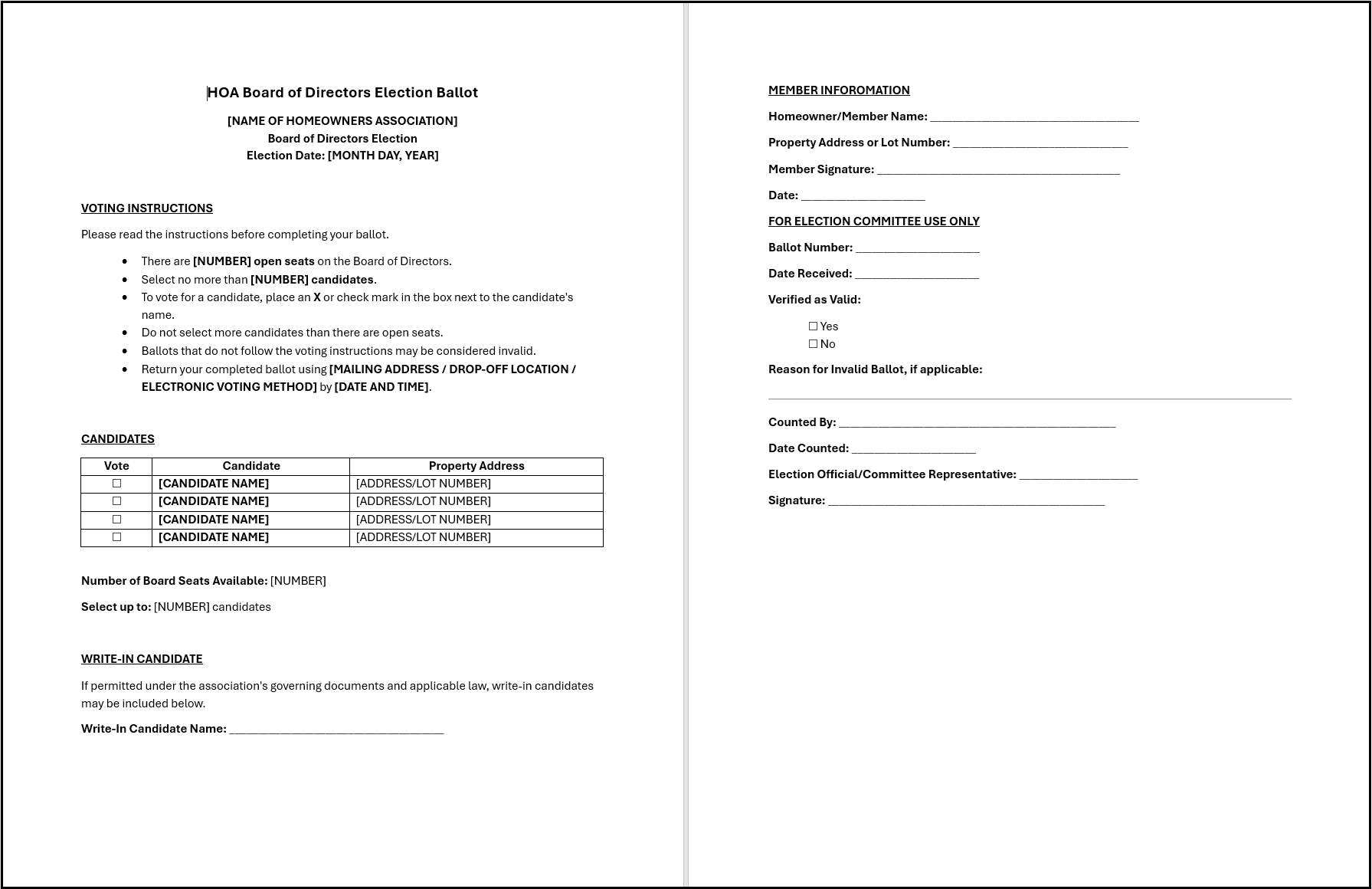
Free HOA Voting Ballot Template

Download Your HOA Election Ballot Template Here

free hoa voting ballot template


Professional Assistance

Navigating HOA voting rules isn’t always easy, especially for self-managed boards. There are several factors to consider, and enforcement requires careful planning and organization. When in doubt, hiring an HOA management company is the best way forward.

Westward360 is a trusted partner for HOAs and condo associations across the United States. For expert association management, contact us today or request a proposal online!


HOA Ballot Counting Procedure: From Ballot Collection To Final Results

Associations must follow the proper HOA ballot counting procedure that state laws and their governing documents set forth. Skipping a step or disregarding the requirements altogether can render the entire process null and void. That said, exact steps can vary depending on the association and the voting method.


What is an HOA Ballot Counting Procedure?

Simply put, the ballot counting procedure is the process that an HOA follows to collect, verify, count, and record votes during an election or membership vote.

This procedure helps ensure that the association only counts valid votes and that the final results are accurate. Typically, the board members are responsible for facilitating this process, but responsibility may also fall on the election committee, an HOA management company, or a third-party inspector.

The steps involved in an HOA ballot counting procedure can vary from one association to another. It ultimately depends on the community’s governing documents, specifically the CC&Rs and bylaws.


Who Should Count HOA Ballots?

In general, ballots are counted by the HOA board, the election committee, an independent inspector, or an HOA management company. Associations must check their governing documents to determine who the responsible party is. Let’s discuss each one below.


HOA Board Members

If state laws and the governing documents permit, board members may count the ballots. This is typically popular among smaller associations that don’t have the manpower or resources to form a separate election committee or hire an independent inspector.

That said, the main concern with this setup is a potential conflict of interest. If incumbent board members are candidates in the election, some may perceive the count as impartial. To avoid this, it is best for board members who are also running for re-election to recuse themselves from the count.


Election Committeehoa ballot tabulation

An election committee is a separate group of people working independently of the board. This committee oversees the election. Tasks often include receiving ballots, verifying voter eligibility, counting the votes, and documenting the results.

Establishing a separate election committee can help ensure the HOA ballot-counting process is fair and transparent. It prevents claims of ballot tampering or manipulation. That said, candidates running in the election must not be allowed to join the committee.


Independent Election Inspectors

In some associations, hiring a third-party election inspector is necessary. California, for instance, requires associations to select an independent third party to act as the inspector of elections (Civil Code Section 5110).

This inspector is completely neutral and independent of the association. They must have no affiliation with the board or any of the candidates.

An independent inspector is more common among larger communities or contested elections. This person or people can receive the ballots, keep them secure, verify voter eligibility, oversee the count, and certify the results. They can also answer any questions regarding the HOA ballot counting procedure.


HOA Management Company

An HOA management company can help facilitate the election on the association’s behalf. Depending on the service agreement, this company may distribute ballots, collect votes, verify voter eligibility, assist with the count, and record the results. It can also prepare any necessary election materials and maintain accurate recordkeeping.

That said, the HOA management company must still follow the association’s governing documents. It can’t make and enforce its own voting procedures. Moreover, the company must never act with bias, favoritism, or personal judgment. Neutrality is key.


Who Can Be HOA Ballot Counting Witnesses?

Generally, all members of the association may observe the HOA ballot counting procedure. This includes board members, candidates, and the voters themselves. As for lawyers or legal representatives, state laws and the association’s governing documents determine if they may witness the count.

Of course, witnesses are not participants. They must not interfere with or disrupt the ballot counting process. Anyone who does may be removed from the area by the association. Depending on the rules, the HOA may also levy a fine against that person.


How Does HOA Count Votes?

In general, the HOA ballot counting procedure involves 10 steps: collecting the ballots, securing the ballots, verifying voter eligibility, checking ballot validity, separating and recording invalid ballots, counting the valid ballots, reconciling the vote, handling ties or disputed results, certifying the election results, and announcing the final results.


1.  Collect the Ballots

First, the association collects the ballots on or before the submission deadline. Depending on the voting method, this may take the form of in-person ballots, mail-in ballots, proxy forms (if applicable), or electronic ballots.


2. Secure the Ballotshoa ballot counting witnesses

Once collected, the ballots must be properly secured until it’s time to count them. The association must store them in a secure place where only authorized individuals can access them. It is also important to document who received and stored these ballots.


3. Verify Voter Eligibility

Next, the election officials must confirm that each ballot was cast by an eligible voter. This includes cross-referencing membership status, ownership records, and voting rights or interests. Proxies must also be evaluated and documented. This step helps minimize duplicate or invalid ballots.


4. Check Ballot Validity

To meet HOA balloting requirements, the association must confirm the validity of each vote. Ballots must come from an eligible voter. Potential issues that may invalidate a ballot include missing information, selecting too many candidates, voting for an ineligible candidate, altered or duplicate ballots, and late submissions.


5. Separate and Record Invalid Ballots

If the association identifies any questionable ballots, it is important to keep them separate from the rest. An election official can review these ballots to confirm that they are invalid. Make sure not to discard them, as these invalid ballots must be stored and documented as well. Furthermore, the association must record the reasons for rejecting each ballot.


6. Count the Valid Ballots

Next comes the HOA vote counting step. This is fairly straightforward, as votes are tallied for each candidate. If the association allows write-in candidates, the election committee must verify candidates’ qualifications and then count the votes. After the first count, it is best to conduct a second count for accuracy.


7. Reconcile the Vote

The HOA ballot counting procedure doesn’t stop after tallying the votes. It is important to ensure that the number of ballots received matches the number of ballots counted plus any invalid ballots set aside. If there are any discrepancies, the election officials must investigate further. It could be due to missing or duplicate ballots.


8. Handle Ties and Disputed Results

Tie votes or challenged elections can happen. When they do, board members must review state laws and the governing documents for the next steps. Most CC&Rs and bylaws address how to break ties, document challenges and decisions, and consider recount procedures to resolve disputes.


9. Certify the Election Results

From there, the election officials must formally confirm the results. This includes the final vote totals, number of valid ballots, number of rejected ballots, and the candidates elected. Certification typically requires the authorized officials to sign a document or report.


10. Announce the Final Resultshoa vote counting

Following the HOA ballot tabulation, the association must then communicate the results to all homeowners. This usually takes place at the election meeting. Many associations also announce the results via the community website, newsletter, member portal, or written notice. This way, even those who failed to attend the meeting are informed.


HOA Ballot Counting Procedure Based on Voting Method

Ballot counting may differ depending on the voting method.

  • In-Person Paper Ballots. These are easy to count, as each ballot is physically reviewed and manually tallied.
  • Mailed Ballots. After receiving a mail-in ballot, the HOA must secure the ballot until the election meeting, where it is counted and tallied manually. Do not open the ballot before the election meeting.
  • Electronic Ballots. Most online voting platforms tabulate the votes electronically. Still, the HOA must use a platform that allows for the verification of voter eligibility and prevents duplicate ballots.
  • Proxy Votes. This is trickier because it requires confirming that the proxy has been properly completed and remains valid before tallying the vote. Additionally, if the person who gave the proxy decides to vote in person, that vote overrides the proxy.

Of course, regardless of the method, associations must still secure every ballot, verify voter eligibility, review ballots for validity, recount the votes for accuracy, and certify the results.


Doing Things Right

Board members must understand and enforce the HOA’s ballot-counting procedure. Failure to do so can invalidate the whole election, costing the association both time and resources. When in doubt, hiring an HOA management company can prove useful.

Westward360 is a trusted partner for HOAs and condo associations across the United States. For expert association management, contact us today or request a proposal online!


Top Tips On Association Insurance Renewal When Rates Are Skyrocketing

Association insurance renewal can be challenging with premiums on the rise. Higher costs can strain an association’s budget and force the board to make difficult decisions. While some choose to cut back on insurance altogether, it is important to strike the right balance and ensure that the community is still well-protected.


Understanding Association Insurance Renewal and Rising Rates

Insurance premiums have increased for many community associations in recent years. There are several factors behind this phenomenon.

One major factor is the rising cost of construction, repairs, and maintenance. Construction materials, labor, and other building expenses have become more expensive. In response, insurance providers have raised their rates to incorporate these costs when claims arise.

Severe weather can also affect insurance rates. Hurricanes, floods, wildfires, storms, and other disasters are known risks for insurers. Associations in areas more susceptible to these weather events typically face steeper premium increases.

Additionally, an association’s claims history can affect insurance rates. If an association frequently files claims, particularly expensive ones, it signals to insurance providers that the community has higher risk exposure. This pushes them to raise HOA premiums.

Finally, the broader insurance market can also play a role. Insurance carriers might reduce their exposure to certain areas or types of properties. Others may stop writing certain policies altogether. With fewer available insurers, associations may find it more difficult to secure competitive rates.


Practical Tips on Association Insurance Renewal

Just because insurance premiums are rising doesn’t mean associations have no options. Here are some strategies for renewing HOA insurance in this climate.


1. Start the Process Early

Boards should begin the association insurance renewal process well before the existing policy expires. Waiting until the last minute puts time pressure on board members. If the HOA fails to secure an affordable rate, it may be forced to opt for the expensive option just to remain insured.

By starting early, HOA boards have enough time to talk to multiple insurance carriers. Boards can review proposals more carefully, ask questions, and negotiate terms.

Moreover, a head start can also provide time to address problems that could affect the renewal. For example, an HOA might need to complete certain maintenance projects before it can obtain a favorable rate.


2. Review the Association’s Current Coveragerenewing HOA insurance

To facilitate a productive association insurance renewal process, the HOA board should evaluate its current policies. The board shouldn’t just renew the same policy without examining it closely. The terms may become outdated, or the HOA’s needs may have changed.

The review should include an evaluation of all insurance policies, including property insurance, liability insurance, D&O insurance, and fidelity bond. Boards should also review coverage limits, deductibles, exclusions, and endorsements.

Furthermore, the board should look for unnecessary coverage. The association may still be paying for coverage that is no longer relevant to the community. This raises insurance costs without realizing it.


3. Get Multiple Insurance Quotes

Associations should obtain quotes from multiple insurance providers. Automatically renewing with the same carrier could cause the HOA to miss out on better options. Comparing proposals can show differences in pricing, coverage, and limits.

Keep in mind that cheaper doesn’t always equal better. A cheaper policy may offer lower premiums, but the HOA could face higher deductibles or more exclusions.


4. Consider Increasing the Insurance Deductible

A higher deductible may reduce an association’s insurance premium. This option can be worth considering when rates are increasing substantially. That said, it is important to determine if the HOA can afford the higher deductible. Jumping to this decision without examining the association’s financial position would be imprudent.


5. Strengthen Risk Management Practices

Better risk management can help reduce the likelihood and severity of insurance claims. It can also show to carriers that the HOA takes risk mitigation very seriously.

Here are some best practices for reducing risk in HOA and condo communities:

  • Prioritize Preventive Maintenance. Boards should facilitate regular inspections to identify and repair problems before they worsen.
  • Improve Security Measures. Depending on the community, this can include lighting, surveillance cameras, and controlled access.
  • Enforce Financial Controls. Implementing strong financial controls can protect against theft, fraud, and similar crimes.
  • Ensure Legal Compliance. Associations should comply with fair housing laws, local building codes, and governing documents to reduce legal risks.
  • Implement Fire Prevention. Fire is one of the most common risks for HOAs and condominiums. Maintaining fire alarm systems, extinguishers, sprinklers, and other safety equipment is not only required, but it can also lower fire insurance premiums.


6. Review the Association’s Claims History

Board members should review the HOA’s claims history before the association’s insurance renewal. This will allow the board to identify patterns that may require attention.

For example, repeated water damage claims could indicate an issue with plumbing or roofing. If the HOA frequently experiences slip-and-fall claims, it may indicate maintenance or lighting issues.

Addressing the underlying cause can greatly reduce incidents and claims. This can put the HOA in a more favorable light for insurance carriers.


7. Keep the Association’s Property Information Updated

Insurers need accurate property information to assess a community. Boards should review details such as building age, size, construction materials, roof age, and improvements. They should also update replacement costs as the economy changes. Underinsuring the property could leave the association without enough money to fully rebuild after a major loss.


8. Don’t Sacrifice Critical Coverage Just to Lower Premiums

Rising premiums can tempt boards to reduce coverage or eliminate it altogether. This is a slippery slope, as the lack of insurance can expose the HOA to greater risks.

Plus, state laws and the governing documents often require insurance. For instance, in Illinois, condominiums are required to carry property insurance, general liability insurance, fidelity bond, and a D&O policy (765 ILCS 605/12).

Reducing coverage limits or removing certain policies may lower insurance costs today, but the association may have to pay for it in higher expenses later on. Board members must act carefully and in the community’s best interest.


9. Account for Insurance Costs in the Budgetrenewing HOA insurance

Insurance is often one of the largest expenses in an HOA’s budget. When insurance rates rise, the budget can become lopsided, with the HOA board allocating more of its income to premiums.

To prepare for this, the board should adjust its revenue expectations. Raising dues or levying special assessments are common courses of action.


10. Communicate Insurance Changes to Homeowners

When insurance rates spike, HOA dues often go up with them. This can cause alarm among homeowners. To limit pushback and maintain transparency, the board should take the time to educate owners. Clearly communicate to them why dues are increasing and how insurance premiums are affecting the association.

In condominiums, if there are any changes to the master policy, the board should inform unit owners as soon as possible. This will allow them to adjust their own HO-6 coverage.


11. Work With an Experienced Professional

Association insurance renewal can be a complicated process. Self-managed boards may find themselves struggling, especially as insurance rates trend upward. For this reason, many communities are turning to an HOA management company for assistance.

Professional management companies know how to navigate the ins and outs of insurance policies. They also maintain a wide network of carriers, potentially giving access to discounts or more favorable pricing.


The Right Balance

Skyrocketing insurance rates can make association insurance renewal a major financial challenge. Fortunately, the strategies and tips above can help control costs while still maintaining adequate protection for the community. When in doubt, don’t hesitate to hire professional services.

Westward360 is a trusted partner for HOAs and condo associations across the United States. To get started on expert association management, contact us today or request a proposal online!


WWT Favicon

Use the search bar below to help locate what you are looking for on our site.