Every association election relies on a set of HOA voting rules. These rules determine voter eligibility, voting methods, and ballot counting procedures. Board members must understand these rules to facilitate fair elections, minimize challenges, and ensure the validity of the results.
What are HOA Voting Rules?
Voting rules are the guiding principles that determine who can vote, how votes are cast, and how the association counts them. These rules can vary depending on state laws and the association’s governing documents.
That said, HOA voting rules commonly address or govern the following:
- The notice period that the HOA must give before the elections (typically 30 days),
- How voters can receive and submit their ballots,
- The minimum number of voters that must be present for elections to proceed (quorum),
- Who can vote (eligibility requirements),
- Whether proxy voting or online voting is permitted and how they work,
- How members can challenge the HOA elections,
- The deadline for voting,
- How to count the votes and announce the results, and
- Other HOA voting process practices as defined by the governing documents.
Who Can Vote in an HOA?
In general, HOA members have the right to vote, but there may be disqualifying factors depending on state law and the governing documents. Let’s take a closer look at those who may be involved in voting.
Members of the HOA (Homeowners)
Voting rights typically belong to the association’s members. Members are often defined as anyone who owns a unit or property in the community.
Generally, each unit or home gets one vote, but this may vary by association. Some communities assign voting power based on ownership percentages, with larger units holding more voting power.
Co-Owners of a Property
A unit or home may have more than one owner and, therefore, more than one vote. That said, it depends on how voting interests are allocated. For example, an HOA may give one vote per lot or unit regardless of how many people own the property.
Tenants and Renters
Can renters vote in an HOA election? In general, renters don’t receive the right to vote simply because they live in the community. Voting rights are reserved for the homeowner, who is the renter’s landlord. That said, some owners/landlords designate their tenant as their proxy.
Delinquent Homeowners
Can a homeowner vote if they owe HOA dues? Many associations revoke a member’s right to vote if they are behind on their dues for a certain period. That said, this is not always the case, so board members must check state laws and their governing documents for confirmation.
What are the Different HOA Voting Methods?
Voting methods depend on state laws and the governing documents, but they typically include in-person voting, absentee ballots, HOX proxy voting, HOOA electronic voting, and mail-in ballots. Let’s discuss each one below.
1. In-Person Voting
With in-person voting, owners may cast their votes at the meeting itself. The association can distribute the ballots either at the meeting or prior to it, but the final submission is made during the meeting proper. Of course, boards must verify voter eligibility when counting votes.
2. Absentee Ballots
If an owner can’t attend the meeting, the HOA may allow absentee ballots. This gives the owner a chance to cast their vote in advance. When using absentee ballots, it is important to clearly establish the submission deadline, where ballots must be sent, and how to verify voter eligibility.
3. HOA Proxy Voting
Can someone else vote for me in an HOA election? If state laws and the governing documents permit, an owner may authorize someone else to vote on their behalf. This is known as proxy voting. That said, associations must enforce clear HOA proxy voting rules, including how to complete proxy forms, when they expire, and how owners may revoke their proxies.
In Florida, Section 720.306 imposes the following requirements:
- The proxy must be dated and signed.
- It must clearly identify the meeting date, time, and location.
- The proxy generally applies only to that specific meeting, even if the meeting is postponed or reconvened.
- The proxy automatically expires 90 days after the meeting date.
- If the proxy form allows it, the person holding the proxy can appoint someone else to vote in their place.
- The homeowner who gave the proxy can cancel it at any time.
4. HOA Electronic Voting
Some states and governing documents allow associations to use HOA online voting under certain conditions. Board members can use an online platform or electronic ballot. That said, this system must be secure and enable the HOA to verify voter eligibility.
5. Mail-In Ballots
Depending on state laws and the governing documents, owners may use mail-in ballots. This allows them to cast their votes even without attending the election meeting. Of course, they must complete and submit the ballots by the deadline.
What Can HOOA Members Vote On?
In general, members can vote on board elections, amendments to the governing documents, special assessments (if applicable), and other major decisions (if applicable).
Not every decision requires a membership vote. More often than not, routine association business continues even with just a board vote. Seeking homeowner approval for every move only slows things down. That said, member votes may be necessary for:
- Board Elections. Electing new directors does require member votes. This is the most common use of voting in an HOA.
- Amendments to the Governing Documents. For changes to the CC&Rs (and even the bylaws), most associations require membership approval.
- Special Assessments. Depending on the governing documents, special assessments above a certain threshold may need approval from homeowners.
- Other Major Decisions. Some decisions require a membership vote as stipulated by the CC&Rs and bylaws. Common examples include building a new amenity, selling HOA-owned property, or dissolving the association.
HOA Voting Rules FAQs
How many votes does each homeowner get?
It depends on the HOA voting rules, as there is no universal formula that applies to every association. Some communities assign one vote per lot or unit, while others allocate voting percentages based on ownership interests. Board members must check their governing documents for confirmation.
What happens if an HOA election does not reach quorum?
If a meeting doesn’t meet quorum requirements, the HOA can’t conduct business or complete the election. Typically, the next step would be to adjourn and postpone the meeting, but the governing documents may give varying instructions.
Can an HOA deny a homeowner the right to vote?
Depending on state laws and the governing documents, an HOA may have grounds to determine that an owner is ineligible to vote. For example, the person may not be an HOA member or may have had their voting rights temporarily suspended due to delinquent dues. That said, the board can’t simply revoke voting rights based on arbitrary rules or personal judgment.
Can an HOA board change the voting rules?
No, board members generally can’t change the HOA voting rules without an amendment. To amend the CC&Rs and bylaws, homeowner approval is typically required.
Can an HOA reject a ballot?
An HOA may reject a ballot if it fails to meet voting requirements. Common examples include late ballot submissions or votes by an ineligible voter. It is essential to adhere to state laws and the governing documents when determining the validity of a ballot.
Can homeowners challenge an HOA election?
If state laws and the governing documents permit, owners may challenge an HOA election. For instance, in Florida, Section 720.306 states that owners have 60 days after the election results are announced to challenge the election process. The governing documents typically outline other requirements and procedures for challenging an election.
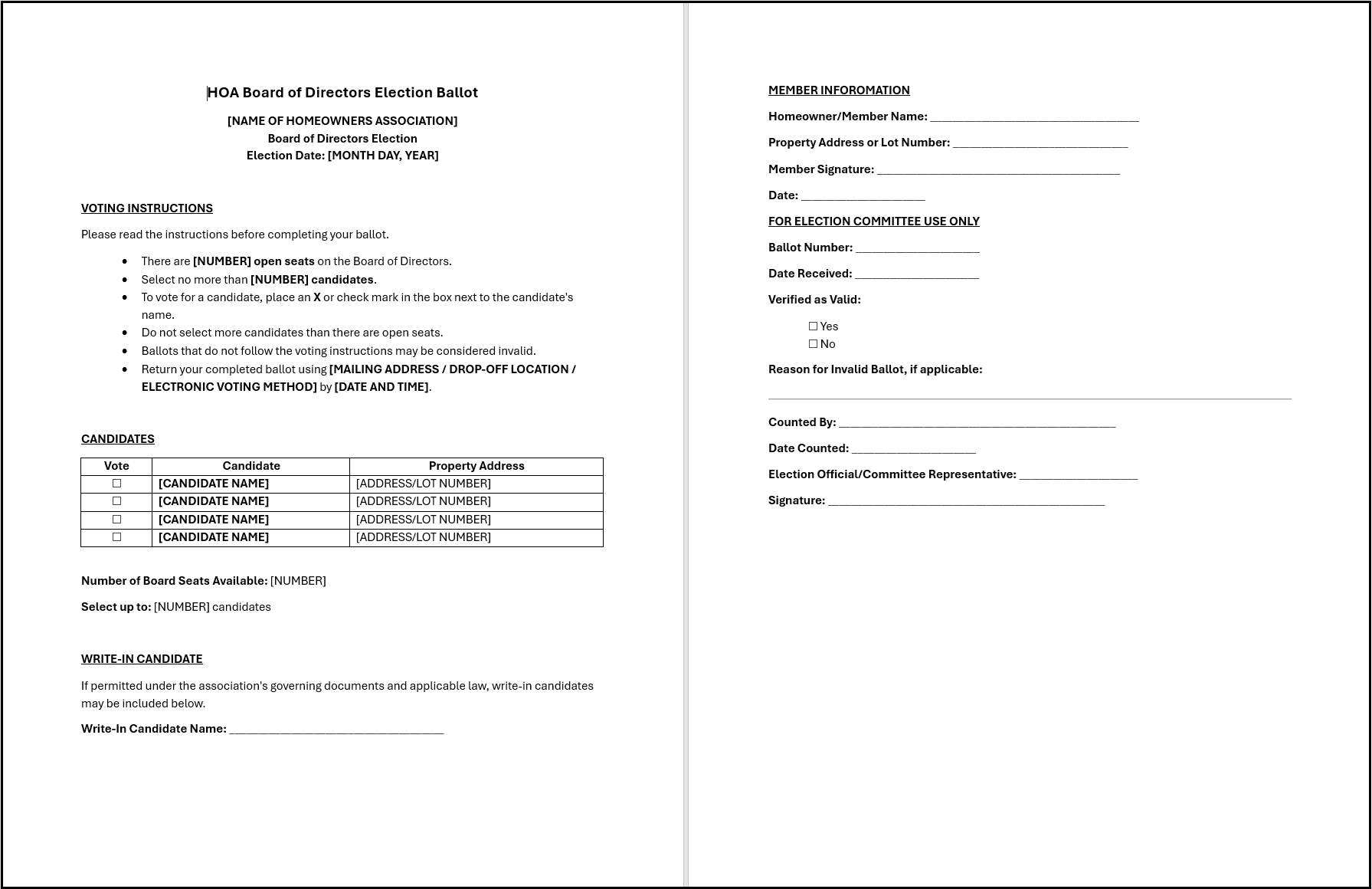
Free HOA Voting Ballot Template
Download Your HOA Election Ballot Template Here
Professional Assistance
Navigating HOA voting rules isn’t always easy, especially for self-managed boards. There are several factors to consider, and enforcement requires careful planning and organization. When in doubt, hiring an HOA management company is the best way forward.
Westward360 is a trusted partner for HOAs and condo associations across the United States. For expert association management, contact us today or request a proposal online!