
What Georgia’s SB 406 Means for Your Community Association

Starting January 1, 2027, most Georgia community associations must file an additional registration with the Secretary of State every year or lose the ability to fine owners, file liens and foreclose. That is the headline of Senate Bill 406, the Georgia Property Owners’ Bill of Rights Act, which Governor Kemp signed on May 12, 2026.
This is a new filing. It is separate from the annual registration your association already files with the Corporations Division, which only keeps the corporate entity in existence.
The law creates a new Chapter 17A in Title 43 of the Georgia Code. It gives the Secretary of State oversight of associations, sets up a state complaint and hearing process for owners, and changes how associations collect, foreclose and keep records. It affects homeowners’ associations, property owners’ associations and, for registration and payment rules, condominium associations.
Below is what changes, when, and what your board should do before the new year.
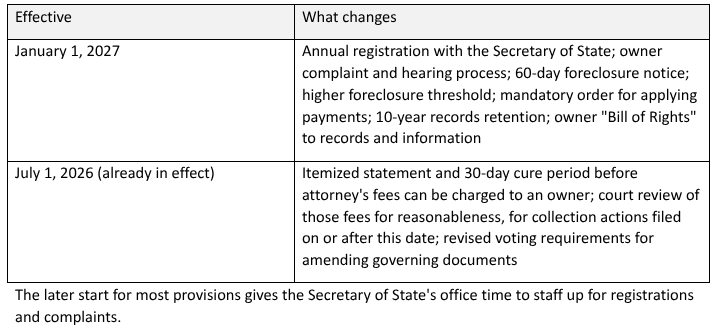
Key dates at a glance
SB 406 phases in over two dates; the January 1, 2027 date carries most of the changes.
Registration with the Secretary of State
From January 1, 2027, an association needs an active state registration to collect fines or fees, file or record liens, or start foreclosure. The registration fee is $100 for the initial filing and $100 for each annual renewal.
As noted above, this is a new filing. It is separate from the annual registration your association already files with the Corporations Division, which only keeps the corporate entity in existence.
Who must register. The Secretary of State reads “owners’ association” broadly: neighborhood HOAs, condominium associations, common interest communities and other groups of property owners governed by covenants or bylaws.
What the filing includes.
- The association’s name, address and a list of current officers
- A complete copy of the governing documents
- A financial statement dated within the past 12 months
Keeping it current. An amended registration is due within 30 days of any change in name, address or officers, or any other change that materially affects the association’s business or control.
If you don’t register. An unregistered association keeps operating, but it cannot fine owners, record liens or foreclose. The Secretary of State can also deny, suspend or revoke a registration, limit fines and fees, or bar an individual from serving on the board for willful violations, misstatements in filings, unpaid fees, or ignoring a state order or subpoena.
How to file. Registration will run through an online portal. The Secretary of State says details will come closer to January 1, 2027.
Owner complaints and state hearings
Owners gain a state-run alternative to court: they can challenge an association’s action, or failure to act, before a Secretary of State hearing officer. The state is already accepting complaints but will not act on them until January 1, 2027.
How an owner complaint moves:
- Complaint. An owner files within 180 days of the association action or inaction that harmed them.
- Automatic stay. Collection of any disputed fines or fees pauses until the hearing officer decides.
- Hearing and decision. A hearing officer reviews whether the association acted within its covenants and governing documents.
- Compliance. Parties have 15 days to carry out the hearing officer’s decision.
- Appeal. Either side can seek court review within 20 days: magistrate court for claims under $15,000, superior court above that.
Associations get their own hearing rights when the Secretary of State acts against them. A hearing must be requested within 10 days of the state’s notice and is held 5 to 30 days after the request. An association that loses an owner-complaint hearing pays an extra $100 administrative fee to the state.
Collections, liens and foreclosure
Foreclosure gets harder and payment handling becomes standardized. The foreclosure changes below apply to associations under the Georgia Property Owners’ Association Act; the payment-order rule also reaches condominiums.
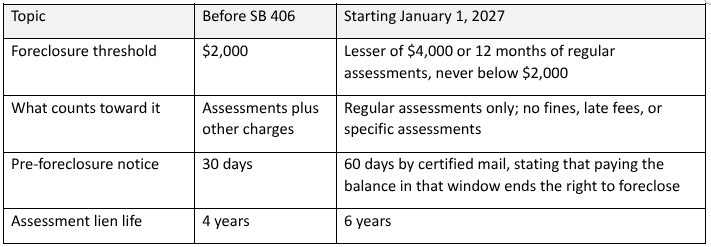
Order of applying payments. Owner payments must go, in order, to: (1) regular assessments, (2) special assessments, (3) specific assessments, then (4) fees and fines. This overrides any different order in your governing documents.
Other collection limits. Associations may not refuse an owner’s payment of assessments, and may not charge or collect accelerated assessments.
Already in effect since July 1, 2026. To pass attorney’s fees on to an owner, the association must first send an itemized statement and allow 30 days to cure. A court must find the fees reasonable before awarding them.
Owner rights, records and meetings
SB 406 writes an owner “Bill of Rights” into state law (O.C.G.A. § 43-17A-7). Owners have the right to:
- Inspect and copy association records, including accounting and banking records, on written request, in line with state law and the governing documents
- Receive the association’s certificate of insurance for coverage that may apply to them
- Get notice of member meetings and attend them; the board must hold a members’ meeting at least once a year
- Receive the statutory notices and process before any foreclosure on their property
Records retention. Registered associations must keep records of assessments, fines, fees, liens and foreclosures for at least 10 years, at an office in Georgia or their principal office.
Expect more records requests. How far the new inspection right overrides limits in existing bylaws is still unsettled, and the Secretary of State’s draft rules on records, meetings and board good faith were the subject of public hearings on November 4–5, 2026.
What your board should do before January 1
- ☐ Budget the $100 registration fee and name who will file once the online portal opens
- ☐ Gather a current officer list, a full set of governing documents and a financial statement dated within the last 12 months
- ☐ Set a process to file amended registrations within 30 days of officer or address changes
- ☐ Update collection letters and ledgers for the payment-order rule, the 60-day foreclosure notice and the new threshold
- ☐ Confirm attorney’s-fee demands include an itemized statement and 30-day cure period
- ☐ Set up 10-year retention for assessment, fine, fee, lien and foreclosure records
- ☐ Prepare a written procedure for owner records requests and insurance-certificate requests
- ☐ Confirm your annual members’ meeting is scheduled and properly noticed
- ☐ Review pending fines and disputes, since owner complaints can pause collection
- ☐ Ask your association attorney to review governing documents against the new law and the final state rules
A note on this summary
This article is general information, not legal advice. The Secretary of State is still finalizing implementing rules, so details may change before January 1, 2027. Please consult your association’s attorney about how SB 406 applies to your community.
Nov 12, 2026 · by Scott Sells, Regional Director, and Eric Staszczak, Executive Vice President
Sources
- Georgia Secretary of State: Property Owners’ Associations Division FAQ
- SB 406 bill text, Georgia General Assembly
- HunterMaclean: Georgia Community Associations Face Major Regulatory Changes Under SB 406
- Thompson Hine: Georgia’s New Property Owners’ Bill of Rights Act
- WTOC: Georgia officials holding two days of hearings on new HOA rules
- CAI: 2026 Georgia End of Session Report